
What a VIP programme actually is
A VIP programme is a price-discrimination model. The operator segments its customer base by expected value and offers larger marginal rebates to the segments that produce the highest gross gaming revenue. That is the whole design. Every visible feature — the tier names, the metallic badges, the birthday cake emoji from your manager — sits on top of that segmentation. For a plain-English read on how these features connect across the market, our reference on non gamstop casinos sets the wider context.
At a UKGC-licensed operator, this segmentation runs alongside a compliance obligation: affordability signals must be reviewed before a player is escalated, and manager contact must not intensify around loss indicators. At a non-UKGC operator, the compliance obligation is materially lighter, so the segmentation runs closer to its commercial optimum. That difference is what makes offshore VIP programmes richer on paper and materially more dangerous for someone at risk.
Some operators publish their tier terms in full. Others publish only the entry-to-platinum ladder and reserve the top tier for manager discretion. Neither approach is inherently more honest; the published ladder can be as opaque as the withheld one if the multipliers and caps are buried in secondary terms.
Anatomy of a tier ladder at an offshore operator
A representative ladder at a mid-market non-UKGC casino runs five visible tiers. Bronze on first deposit; silver at a low four-figure LP total; gold at low five figures; platinum at high five figures; diamond by review. The multipliers on points earning double or triple by the time a player reaches platinum, which shortens the time required to hold the tier once a player reaches it.
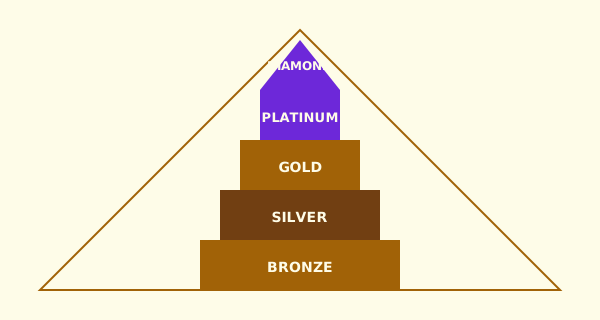
The multiplier structure has a practical implication. A player at bronze earning one point per pound wagered has to wager a hundred pounds to earn a hundred points. A player at platinum earning three points per pound wagered generates the same hundred points on thirty-three pounds. Progression, in other words, is easier from platinum upward than from bronze upward. That asymmetry is deliberate: it means players who reach platinum are hard to displace, and their tier feels rewarding in a way lower tiers do not.
| Tier | Typical LP floor | Points multiplier | Effective earn rate |
|---|---|---|---|
| Bronze | 0 | 1x | Baseline |
| Silver | 1,000 | 1.25x | Slight lift |
| Gold | 10,000 | 1.5x | Noticeable |
| Platinum | 50,000 | 2x | Material |
| Diamond | By review | 3x | Large |
Read the multiplier column carefully. A three-times earn rate at diamond does not mean the point-to-cash rate improves. It means the pace of tier consolidation improves — the operator is rewarding continued play, not rewarding past play. That distinction is central to understanding how these programmes retain top players.
Loyalty points versus status points
Most offshore VIP programmes track two point balances. Loyalty points are the spendable currency — the balance that converts to cash or free spins at the redemption page. Status points are the internal metric that drives tier progression. Both are earned on wagers, but the earning ratios and expiry rules differ.
Status points typically do not expire, but they can be reset by dormancy. Six months without qualifying wagers is a common reset window at Curaçao-licensed operators. Loyalty points typically expire on a shorter clock — 90 or 180 days after last accrual — and the operator has an incentive not to remind you of the expiry.
- Loyalty points fund the small everyday rebates that keep a session going.
- Status points drive the tier progression that unlocks the larger monthly and quarterly perks.
- The two balances are often displayed in the same location on the account page, which reduces the chance a player will spot the difference.
- Some brands separate a third balance for tournaments, further obscuring the effective rebate.
The consumer implication is straightforward. Any calculation of a VIP programme's effective rate has to be done on the status-points ladder as well as the loyalty-points ledger, otherwise the effective return looks either better or worse than reality.
Invitation triggers behind the marketing copy
Public tier ladders are not the only route into a VIP scheme. Managers can offer invitations directly, and the trigger is almost always a CRM signal rather than a raw LP total. From what we can reconstruct from public interviews with former retention staff and from operator documentation surfaced during regulatory reviews outside the UK, the trigger set has four dimensions.

- Deposit volume. Total deposits over a rolling window, typically 30, 60 or 90 days. Absolute floor is usually mid-four figures.
- Turnover conversion. The ratio of turnover to deposit, which flags a player who churns balances through slot volume rather than a player who withdraws frequently.
- Session cadence. Frequency and length of sessions. A player logging on daily for short sessions is a stronger retention prospect than a player depositing large amounts weekly.
- Payment stability. Consistent use of the same payment method reduces the operator's compliance load and improves the invitation score.
Three of those four dimensions have nothing to do with money at all. The invitation is being offered because the retention model predicts your continued play is a reliable stream of gross gaming revenue, not because you have earned anything in a moral sense.
Tier benefits audit — what actually changes
What genuinely changes when a player moves from silver to platinum? An honest audit sits somewhere between the marketing summary and the cynical reduction that "nothing does". The four benefits with real substance are: withdrawal queue priority, dedicated support access, higher deposit and withdrawal limits, and slightly higher cashback percentages. Everything else — birthday bonuses, tournament entries, hospitality invitations — is a lever the operator can vary at will.
| Benefit | Silver | Gold | Platinum | Diamond |
|---|---|---|---|---|
| Weekly cashback ceiling | 5% | 7% | 10% | 12-15% |
| Withdrawal priority | Standard | Priority | Same-day | Same-day, no cap |
| Manager access | Chat | Direct dial | ||
| Comp point multiplier | 1.25x | 1.5x | 2x | 3x |
The consumer question is whether the improvement between silver and diamond justifies the additional turnover required to hold the higher tier. For most players, the honest answer is no: the incremental cashback percentage does not cover the incremental variance in expected loss, and the withdrawal-priority benefit is worth hours rather than days. The operator, of course, is not trying to answer that question honestly; the marketing is engineered around the upgrade.
Retention timing and the CRM calendar
CRM calendars at offshore operators follow patterns that a well-informed consumer can predict. Monday reload offers are typically calibrated against the weekly deposit trough. Wednesday manager contact is timed against a mid-week engagement dip. Friday to Sunday communication is the retention peak — the pre-weekend reload, the weekend tournament, the "we'll double your Saturday deposit up to five hundred" message.
A specific pattern worth naming is the "birthday period". Many programmes maintain an extended birthday window — anything from a week to a month — during which the manager will contact the player repeatedly with staged offers. That is not warmth. It is a rehearsed retention sequence, and the specific offers are chosen from a menu based on the player's segmentation. The birthday flourish is real; the underlying operation is scripted.
The relevant defensive posture, for any consumer inside a VIP programme at a non-UKGC operator, is to know the calendar as well as the CRM does. If a message arrives on the day and at the time your usage data predicts a deposit dip, treat that as the retention signal it is.
Downgrade rules and dormancy
Tier retention is almost never permanent. Every offshore VIP programme reserves the right to downgrade a player who fails to maintain a defined level of activity across a review window. That window is typically a calendar month for lower tiers and a calendar quarter for the top tiers, with a "protected period" of one full downgrade cycle after which the tier resets to the next-lowest level.
- Silver downgrades if monthly LP falls below the silver floor.
- Gold downgrades if quarterly LP falls below the gold floor, though a one-month protected period usually applies.
- Platinum downgrades on a quarterly review, and only after a second consecutive quarter below floor.
- Diamond downgrades by manager discretion, which in practice means a targeted retention offer arrives before the downgrade lands.
The design here is not accidental. The steeper the tier ladder, the more valuable the sunk-cost feeling on the way down. A player facing an imminent downgrade often deposits specifically to preserve the tier, which is precisely the behaviour the operator's design elicits.
KYC and source-of-funds at higher tiers
Higher tiers do not remove KYC. In many cases they raise the bar. Offshore operators licensed by Curaçao's GCB have obligations under the jurisdiction's AML framework, and Anjouan and Malta operators sit under their own equivalent regimes. Where a player's cumulative deposits exceed defined thresholds — commonly ten thousand euros or its equivalent in a rolling window — a source-of-funds request is standard practice and, if not completed, blocks further withdrawal.
Source-of-funds requests at a top tier typically ask for payslips or business income documentation, bank statements covering the deposit period, and in some cases proof of the payment source used. This is not surprise regulation. It is the same AML architecture that operates at UKGC-licensed operators, applied by a different regulator. The difference is that a UKGC operator is required to review this proactively; an offshore operator can review at withdrawal.
Non-UKGC programmes vs UKGC compliance
The 2023 UK White Paper "High Stakes: Gambling Reform for the Digital Age" tightened UKGC-licensed VIP compliance in three concrete ways. First, VIP invitations to any player with financial-vulnerability indicators are prohibited. Second, manager contact must not concentrate around loss events. Third, any VIP status offered must be justifiable against a documented affordability review.
None of those obligations bind operators licensed only by Curaçao or Anjouan. In practice the difference is visible: offshore VIP terms remain more generous on the headline percentages, but the compliance protections that make UKGC schemes safer for at-risk players are largely absent. Consumers should not read the offshore generosity as pro-consumer; the extra rebate is priced against the reduced consumer protection.
The credit-card ban that has applied in the UK online market since April 2020 also does not cross-apply. Offshore operators can and do accept credit-card deposits, and some VIP reload offers are specifically designed to accept credit-funded top-ups. That is a specific consumer risk pattern worth noting: a credit-funded platinum reload can convert a large paper loss into a real personal debt inside a single session.
Frequently Asked Questions
How long does it take to reach platinum at an offshore operator?
For most published ladders, mid-five-figure turnover across three to six months is a realistic mapping to platinum. The exact figure varies by operator and by game mix, since slot wagering earns points at a different rate to live dealer.
Are VIP tier reviews backwards-looking or forwards-looking?
Both. Retention teams look at trailing deposit and turnover, and forecast the coming quarter's contribution before upgrading a tier. That is why a strong recent month can trigger an upgrade even if the twelve-month picture is uneven.
Do points earned lapse if I stop playing?
Most programmes apply dormancy rules. Six months of inactivity typically resets accumulated LP to zero, and some brands operate a shorter 90-day loyalty-point expiry alongside a longer status-point clock.
Can I opt out of manager contact?
Yes at reputable brands. Opt-out preferences do not always propagate across all channels, however, so email, SMS and messenger opt-outs may need to be requested separately.
Do tier benefits stack with public promotions?
Sometimes, but exclusion clauses are common and are often only visible in the terms of the specific promotion. Read the "eligibility" section of any reload offer before opting in.
Is the VIP scheme different on desktop and mobile?
The scheme itself is the same. Some perks such as event tickets or hardware giveaways may only surface through manager contact rather than the app, and mobile-only push offers are usually a lower-value subset of the full menu.
Responsible Gambling
Every VIP programme is designed to keep you playing. The tier ladders in this article, the multipliers in the table, the invitation triggers behind the copy — all of them work because they produce continued wagering. If you are reading this because you are curious about how the machinery operates, that is fine. If you are reading it because you are trying to justify the next deposit, please stop.
GamStop is the UK's national self-exclusion register, operated by National Online Self-Exclusion Scheme Limited. It is free, and it is genuinely effective at what it does: preventing UKGC-licensed operators from opening or maintaining an account for anyone registered with the service. If you have previously used it and are looking at offshore VIP programmes, the pattern that produced the original exclusion is being reactivated, and no amount of tier rebate offsets that risk.
Free and confidential support is available. GamCare operates a 24-hour helpline on 0808 8020 133. Gordon Moody provides residential treatment programmes for severe cases. The NHS National Gambling Clinic offers specialist care through referral. BeGambleAware maintains independent information services. GAM-Anon offers structured support for family members affected by another person's gambling. These are text references, not links; the appropriate first step is to contact one of these services directly.
Background legal context is available at the Gambling Act 2005 on legislation.gov.uk and via the general-purpose gov.uk portal. Comparative material on consumer-protection frameworks is available at the OECD.

Amelia examines VIP, loyalty and cashback programmes across offshore operators, mapping the fine-print behind headline rates and what triggers VIP-tier reviews.