
What VIP programmes at non GamStop casinos really are
A VIP programme, translated into plain UK English, is a retention pricing model. The operator offers a marginal benefit — a cashback fraction, a comp-point rebate, a birthday bonus, a manager on WhatsApp — in exchange for continued deposits within a defined window. The point of the programme is not to reward you for having played. The point is to make your next session more likely.
At offshore operators licensed by the Curaçao Gaming Control Board, Anjouan Offshore Gaming or occasionally the Malta Gaming Authority, VIP structure is a competitive lever. These operators cannot rely on the same distribution channels a UKGC-licensed brand uses, so they lean into loyalty. Read the VIP programme breakdowns we publish for the mechanical detail; the summary is that headline rates rarely match effective rates once game weighting, caps and expiry are applied.
Because these operators do not participate in GamStop, someone who has previously self-excluded through the UK register can still open an account on the strength of email plus card details. That is not a feature. That is the compliance gap the offshore market runs on, and it is exactly why loyalty machinery works so effectively on players who should not be inside a casino at all.
We approach VIP structure as an investigation, not a shopping guide. Every claim in the tier ladders and comp rates on this site is checked against the operator's own published terms, then cross-checked against the friction a player hits at withdrawal. The gap between the two is where consumer harm concentrates.
Tier structures: bronze, silver, gold, platinum, diamond
Almost every non-UKGC operator uses a metallic ladder. Bronze at entry, then silver, gold, platinum and diamond at the top. Some brands add a sixth invisible tier — variously badged as Elite, Sapphire, Onyx or Black — which is not published on the marketing site at all and is only offered by manager invitation. The visible ladder is designed to feel navigable. The hidden top is designed to feel exclusive.

Progression is measured in loyalty points, which are earned from wagers, not from deposits. That distinction matters. Two players with identical deposit histories can sit at different tiers if one plays high-volatility slots with heavy dormancy and the other plays low-volatility slots at long session length. The programme rewards session behaviour that keeps a player in the seat.
The published thresholds we have surveyed sit in a fairly narrow band across the offshore market. Bronze is typically automatic on first deposit. Silver activates around a thousand loyalty points, which broadly maps to a thousand pounds of turnover on non-slot games. Gold and platinum push into the tens of thousands of loyalty points. Diamond is often described as "by review" — meaning the manager approves it — with an unpublished floor.
| Tier | Typical LP required | Typical monthly cashback | Manager access |
|---|---|---|---|
| Bronze | 0 (auto) | 3-5% | Chat only |
| Silver | 1,000 | 5-7% | Chat, faster queue |
| Gold | 10,000 | 7-10% | Named agent |
| Platinum | 50,000 | 10-12% | WhatsApp/Telegram |
| Diamond | Undisclosed / by review | 12-15% | Direct dial |
The unpublished nature of the top tier is worth pausing on. A programme that discloses its bronze-to-platinum ladder but withholds diamond thresholds is a programme where the operator retains full discretion over who receives the largest rebates. That is helpful commercially and unhelpful to the consumer trying to make a rational decision about expected return.
Comp-point mechanics and their real cash value
Comp points, sometimes styled as loyalty points, LP, casino coins or CC, are the internal currency that drives tier progression. The headline conversion rate at most offshore casinos looks generous — a hundred points per pound wagered is common — until you check the point-to-cash rate at the redemption page. There, one point typically converts to less than half a penny.
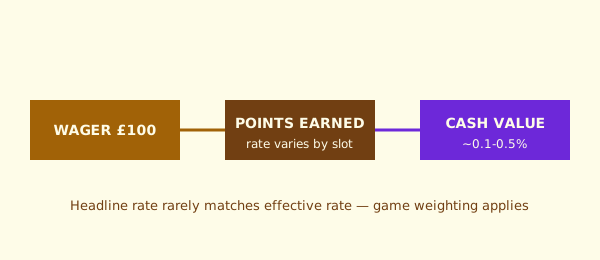
Do the arithmetic. If a hundred pounds of turnover on slots produces one thousand points, and each point converts to 0.001 pounds, the effective rebate is one pound — exactly one percent of turnover. That is the ceiling. In practice, game weighting drags the effective rate lower. Table games often earn ten percent of the slot rate. Live dealer earns anywhere from zero to twenty. Jackpot slots frequently earn nothing at all.
The cashback breakdown we publish shows how those weighting rules interact with cap rules. The short version: a headline conversion rate that appears attractive when read on the promotions page can collapse to a fraction of that once real-play weighting applies. That is not accidental design. It is how the effective rate is engineered to stay inside the operator's target retention cost.
Some brands sweeten the maths at the top tiers, offering diamond-level players a five-times point multiplier on selected slots for a limited window. This produces genuine value on paper — and near-guaranteed session extension in practice, because the multiplier is worthless if you cash out early. The rebate you receive is smaller than the additional turnover you generate to unlock it.
Cashback types: net-loss vs turnover vs deposit-based
Cashback at non-UKGC operators is not one thing. It is at least three, and the differences matter to any consumer trying to price the promotion honestly.
- Net-loss cashback pays a percentage of the amount you have actually lost across a given window. A ten-percent monthly net-loss cashback means if you deposited a thousand and withdrew four hundred, the six-hundred net loss produces sixty pounds of cashback.
- Turnover cashback pays a fraction of a percent of total amount wagered, regardless of outcome. A 0.5% turnover cashback on twenty thousand pounds of slots wagering produces a hundred pounds, whether the session was profitable or catastrophic.
- Deposit-based cashback pays a small percentage of deposits themselves, capped and often with a wagering requirement attached before withdrawal.
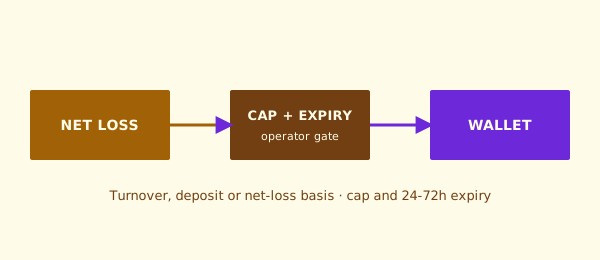
Turnover cashback tends to be the safest for the operator, because it prices retention in a way that does not depend on outcome. Net-loss cashback looks the most player-friendly on the surface but rewards heavy losing sessions, which is the opposite of a helpful design signal for anyone at risk. Deposit-based cashback usually carries wagering strings that neutralise the headline value.
The rebate you eventually see also depends on when cashback pays: instant cash to the real wallet is rare. Most offshore programmes credit cashback as a bonus balance, which means it is subject to a wagering requirement — commonly one times or three times — before withdrawal.
Cashback caps and expiry windows
Every cashback offer worth reading has three numbers behind it: the headline percentage, the cap, and the expiry window. The headline percentage attracts sign-ups. The cap protects the operator against volatility. The expiry window drives session frequency.
- Check the cap. A "up to fifteen percent cashback" line often collapses to a five-hundred-pound ceiling per week. A player wagering a low five-figure amount will hit that ceiling long before the headline rate matters.
- Check the expiry. Cashback credited to bonus balance frequently expires 24, 48 or 72 hours after posting. A player who is on holiday, unwell or simply not gambling will forfeit the balance entirely.
- Check the wagering multiplier. Zero-times cashback exists but is rare. One-times or three-times is the norm at offshore operators, which softens the effective value.
- Check whether the cashback replaces or stacks with tier-based rebates. Some programmes explicitly exclude cashback weeks from LP accrual, which is a hidden cost.
- Check for game weighting. Cashback often excludes live-dealer wagering entirely, or applies at a materially lower weight.
Once you have those five numbers, the effective rebate is straightforward to price. The problem is that most players never do this because the operator marketing places the headline percentage in fifty-point type and the cap and expiry in the footer.
The consumer implication is clear: cashback is a session-frequency instrument, not a loss-mitigation tool. It exists to increase the number of weeks in which you play, not to reduce the total amount you lose.
Personal account manager: friend or KPI-driven salesperson?
By the time a player reaches gold or platinum on a non-UKGC programme, a personal account manager has usually appeared. The manager introduces themselves by name, offers a direct WhatsApp or Telegram channel, and begins to send birthday messages, weekend reloads and occasional invitations to private tournaments.
The relationship is not a friendship. The manager is measured on retention KPIs — sometimes deposit retention, sometimes wagering retention, sometimes both — and their bonus is calculated against the value the assigned book of players produces in the coming quarter. That is not sinister; it is simply the commercial reality of how CRM teams are paid inside offshore gambling operations. It is only sinister when a player begins to interpret the relationship as personal loyalty rather than commercial retention.
Two behaviours are worth noting. First, managers tend to reach out at moments of dormancy. Three days without a deposit is a common trigger; longer if the player is a heavy depositor whose absence would materially move the book. Second, managers tend to reach out after a heavy losing session with a "recovery" offer — a targeted reload, a personal cashback, a free-spin package. That specific pattern is why regulators outside the UK have started to scrutinise CRM contact logs.
Invitation-only tiers and their trigger thresholds
The visible ladder ends at diamond. The invisible ladder above it — sometimes marketed with initials like BC, ES or SP — is where the operator's most valuable players sit. Invitations are not automatic. They are typically triggered by a combination of three signals inside the CRM: sustained deposit volume, active session cadence, and a stable payment method.
Reported thresholds are hard to pin down because the operator has an incentive to keep them off-page. From the terms we have surveyed and the confirmations we have received from public interviews with former CRM staff, the entry point for an invitation-only tier tends to cluster around a five-figure deposit total across a rolling ninety-day window, with matching turnover.
What comes with the top tier varies. Higher table limits, private live-dealer tables at commercial studios, expedited withdrawal without daily caps, and — at the largest operators — event tickets and travel offers. That last category is where UK consumers should be most cautious: hospitality outside a UK regulatory perimeter is not covered by any UK dispute mechanism, and the offer usually sits inside a broader retention plan.
Reload bonuses vs VIP-tier reloads
Every offshore casino publishes a reload calendar. Monday reload, midweek boost, weekend match — the marketing calendar is designed to give players a reason to log in on days they would not otherwise deposit. A VIP-tier reload is different in three ways.
First, it is targeted. It arrives by direct message from a named manager, not on the public promotions page. Second, it is often larger — a hundred and fifty percent match rather than the fifty percent on the public reload — and applies to a smaller deposit ceiling. Third, it usually has a shorter wagering multiplier attached, which produces a headline that looks more player-friendly than the public reload.
The problem is that the targeted reload is timed against your CRM signals. If the manager sends a fifty percent match on a Tuesday morning, it is almost certainly because your average Tuesday deposit is below your weekly mean. If the manager sends a two-hundred percent match after a difficult weekend, it is because loss data has moved into a retention-risk band. The reload is not a gift. It is a re-entry mechanism.
Read the wagering multiplier and the maximum bet clause carefully. Many VIP reloads carry a "maximum bet while bonus is active" line — commonly five pounds — that voids the bonus if breached. That clause is not always highlighted, and its enforcement at withdrawal is where most VIP-reload disputes concentrate.
Faster withdrawal as a VIP perk
The most genuinely useful VIP perk at non-UKGC operators is a faster withdrawal queue. Standard withdrawal at an offshore casino can queue for up to 72 hours in the pending phase before processing begins; a VIP tier commonly compresses that to same-day or next-business-day payment. That is a real service improvement, and it is where the case for a mid-tier VIP scheme, from the consumer's perspective, is strongest.
But the caveat matters. Faster does not mean immediate. KYC still runs at withdrawal — that is jurisdictional obligation, not a friction the operator can lift — and complex cases (mismatched addresses, large first withdrawals, payment method changes) still queue behind compliance review, regardless of tier. VIP status compresses the routine queue. It does not remove the checks that protect against money-laundering risk.
Some programmes advertise "instant withdrawals" as a VIP perk. In practice, "instant" is a marketing word rather than a technical one: crypto rails do settle quickly once released, but the operator's internal approval step is not itself removed by the crypto choice. The gain versus a standard wire is measured in hours saved, not immediacy.
VIP-only tournaments and leaderboard mechanics
Tournaments are the operator's cheapest retention instrument. A ten-thousand-pound prize pool distributed across the top thirty finishers can produce hundreds of thousands of pounds of turnover in a week. VIP-only tournaments raise the stakes and narrow the field, which increases the required turnover per participant to place.
| Tournament type | Typical entry | Turnover required to place | Prize skew |
|---|---|---|---|
| Public daily race | Opt-in, free | Low four-figures | Top 50 |
| Public weekly leaderboard | Opt-in, free | Mid four-figures | Top 100 |
| VIP tier race | Invitation, free | High four to low five-figures | Top 30 |
| Private high-stakes race | Manager invitation | Five-figures | Top 5 or 10 |
The leaderboard geometry favours the top few. In most public daily races, the top prize is thirty to fifty percent of the total pool, with a rapid taper to token amounts by position twenty. VIP tournaments accentuate that skew — the top three positions may take seventy percent of the pool. That skew turns the tournament into a game of attrition: the player prepared to grind the largest volume in the shortest window wins, which is the exact behaviour a retention team wants to induce.
For a UK consumer looking rationally at expected value, the tournament rarely improves it. The additional turnover required to place typically outweighs the prize expectation for any position below the top five, and even top-five expectation only breaks even at variance levels that most consumers do not have the bankroll to sustain.
Cross-operator VIP networks and portability
A small number of offshore operator groups share loyalty status across brands. If you have reached platinum at brand A, and brand B sits inside the same corporate group, a manager at brand B may honour your tier when opening a second account. This is worth being aware of for two reasons.
First, it can reduce the perceived cost of trying a second operator, because the "restart from bronze" friction disappears. Second, it means the shared group has visibility across all your accounts inside the group, even if you registered independently at each brand. From a data perspective, "portability" is less a gift to the consumer and more a consolidation of your session profile across the operator's stable.
Portability outside a corporate group is rare. Independent affiliate networks occasionally negotiate cross-brand matching for their high-value players, but that is a bilateral arrangement between the affiliate and the receiving operator, not a market-wide standard. Anyone told that "your platinum at operator X automatically becomes platinum at operator Y" should assume there is a shared parent or a specific commercial deal behind the offer.
Warning signs: VIP programmes that trigger relapse
Certain patterns inside a VIP programme correlate with problem-gambling relapse. These are not universal, but they are documented in the academic literature and in regulator publications outside the UK, and they are worth naming plainly.
- Contact intensification after a losing session. Increased manager outreach in the 24 hours after a heavy loss is a retention-response pattern, not a welfare check.
- Recovery bonuses. A named "come-back" or "we-miss-you" reload after a period of dormancy is designed to reactivate a lapsed player. If you paused deliberately, an incoming offer is not neutral.
- Escalating deposit limits. Programmes that request a "temporary lift" of a deposit limit in exchange for a VIP perk are trading the player's own safety mechanism for a marginal rebate.
- Sport hospitality invitations timed against significant deposit periods. These are audit-red inside UK-licensed operators post-2020 and remain a common retention tool in the offshore market.
- Persistent late-night outreach. Managers messaging outside standard hours often correlates with regulator-flagged patterns of vulnerability.
If any of these patterns feel familiar in your own history at a non-UKGC operator, the appropriate response is not to renegotiate tier terms. It is to stop depositing at that operator and to consider registering with the non gamstop casinos section on GamStop — the register that exists to prevent UK-licensed operators from opening or maintaining an account with you.
How UK-licensed operator VIP schemes differ under the 2023 White Paper
Since the 2023 UK Government White Paper "High Stakes: Gambling Reform for the Digital Age", the compliance framework around VIP programmes at UKGC-licensed operators has tightened significantly. UK operators are now required to demonstrate that VIP status is not offered to anyone at heightened risk, that manager contact does not concentrate around loss signals, and that VIP thresholds do not incentivise wagering that exceeds financial capacity.
None of these obligations apply at operators licensed only by Curaçao, Anjouan or, in many cases, Malta when serving markets outside the MGA's home perimeter. That is the compliance gap. The consumer implication is that the VIP schemes described on this site are structurally different from those at UKGC-licensed brands even where the tier labels and cashback percentages look similar on the surface.
The White Paper also introduced stake limits on online slots — currently five pounds for adults and two pounds for eighteen-to-twenty-four year olds — and continues the credit-card ban that has been in force in the UK online market since April 2020. Non-UKGC operators are not bound by either measure. Consumers should factor that into any comparison between offshore VIP terms and their UKGC-licensed counterparts.
Frequently Asked Questions
Are VIP programmes at non GamStop casinos regulated?
They are governed by the operator's home regulator — most commonly Curaçao, Anjouan or Malta — not the UK Gambling Commission. Protective conditions vary widely by jurisdiction and are generally lighter than the UK's post-White-Paper framework.
Do comp points hold real cash value?
Yes, but the effective conversion is typically a fraction of a percent of turnover once game weighting is applied. Headline conversion rates rarely reflect real-play conditions.
Is cashback safer than a bonus?
Cashback carries fewer wagering hurdles than a standard bonus but often has caps, expiry windows and net-loss thresholds that reduce its real value. It is a retention instrument, not a safety net.
What triggers a VIP invitation at an offshore site?
Consistent deposit and turnover across a defined window — sometimes as short as thirty days — combined with session-frequency signals and a stable payment method.
Are personal account managers regulated?
Account managers at non-UKGC operators work to retention KPIs and are not bound by UK affordability check rules or the post-2020 UKGC audit obligations around VIP contact patterns.
Do VIPs receive faster withdrawals?
Frequently yes, though KYC checks still apply at withdrawal and complex cases still queue behind compliance review, regardless of tier.
Can I transfer VIP status between operators?
A small number of corporate-group networks match tiers between sibling brands, but portability is not standard across the offshore market. Cross-brand claims should be checked carefully.
Responsible Gambling
VIP programmes intensify commercial pressure on players who are already spending significantly. Anyone who has previously self-excluded through the UK's national self-exclusion register — a service operated by National Online Self-Exclusion Scheme Limited — is by definition someone the UK regulator has recognised as needing distance from online gambling. Continuing to deposit at offshore operators after such a registration removes the protective effect and typically restarts a pattern that the exclusion was created to interrupt.
If you are considering a VIP scheme at an offshore operator, the honest question is not "which tier should I aim for". It is "am I already spending more than I can afford to lose". A programme designed to reward larger, more frequent spending is, by definition, calibrated against the answer to that question being "yes".
Practical resources exist and are worth using. GamCare operates a 24-hour helpline on 0808 8020 133. Gordon Moody offers residential treatment and specialist online groups. The NHS National Gambling Clinic provides free treatment on referral. BeGambleAware maintains an independent information service. GAM-Anon supports families affected by problem gambling. We list these here as text-only references — the appropriate first step is to contact one of these services directly rather than through any operator link.
The relevant legal framework is public. The Gambling Act 2005 is the primary statute, and the UK Gambling Commission publishes its licence conditions and enforcement decisions openly. Broader consumer protection background is available at Wikipedia's summary of the 2005 Act and via general UK government resources. International comparative context is available from the OECD.
Concrete safeguards for anyone reading this: set a hard weekly deposit limit before the session starts, not after; use the banking-side tools your card issuer offers to block gambling transactions; separate the phone number registered at any casino from your personal number so promotional contact can be silenced; and treat every WhatsApp message from a named manager as the retention outreach it is, rather than as a personal relationship.

Amelia examines VIP, loyalty and cashback programmes across offshore operators, mapping the fine-print behind headline rates and what triggers VIP-tier reviews.