
Defining the high roller segment
"High roller" is an operator's word, not a regulator's. At a UKGC-licensed brand, "VIP" is a defined status with published affordability obligations attached. At an offshore operator, "high roller" is an internal segmentation label applied to accounts whose expected quarterly gross gaming revenue exceeds a defined floor. For the broader landscape context, our reference on non gamstop casinos covers where this segment sits inside the wider offshore market.
Every mid-market non-UKGC casino runs a version of this segmentation. The label may be "high roller", "elite", "black", "diamond plus" or something more coded, but the underlying model is the same: identify the accounts that produce the majority of gross gaming revenue, allocate them to named retention staff, and offer terms unavailable to lower-value accounts. That is the entire operating logic.
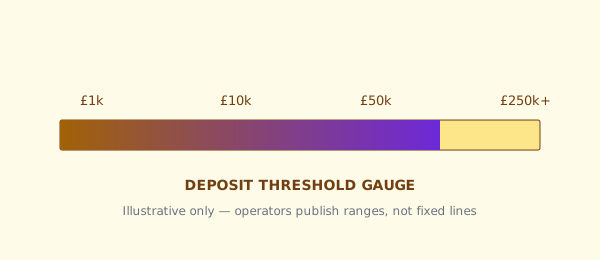
The published marketing language rarely reflects the internal reality. A public "high-roller welcome pack" at fifty-percent match up to five thousand pounds is not the offer a genuine high-value account will see; it is a customer-acquisition promotion designed to identify prospects. The genuine high-roller offer arrives after a manager has reviewed a first-month deposit pattern.
Threshold mechanics and monthly banding
Retention teams at non-UKGC operators segment accounts into bands, typically monthly, on trailing deposit and turnover. The bands themselves are proprietary and vary between operators, but the shape is consistent. A representative structure at a mid-market Curaçao brand looks approximately as follows.
| Band | Monthly deposit range | Typical treatment | Personalisation |
|---|---|---|---|
| Standard | Below £1,000 | Public promotions only | None |
| Regular VIP | £1,000 - £5,000 | Tier ladder benefits | Automated CRM |
| High roller | £5,000 - £25,000 | Manager assignment | Named agent |
| Whale | £25,000 - £100,000 | Custom retention plan | Direct-line manager |
| Super whale | Above £100,000 | Bespoke, board-level review | Executive contact |
These bands are not fixed and are not published. They are operational thresholds inside the retention model, and their movement quarter to quarter reflects the operator's own risk appetite as much as the individual player's spending. A player moving between bands mid-month is treated according to the trailing band until the next review.
What the banding really means, from a consumer perspective, is that the offers a player sees are calibrated to keep them inside their current band. A high-roller account showing a downward trend receives increased outreach designed to prevent a slide into the regular VIP band. That is the CRM working as designed.
Dedicated managers and retention economics
The named account manager is the single most concrete benefit at the high-roller level. That manager typically handles a book of somewhere between eighty and two hundred accounts. Their compensation is split between salary and a quarterly retention bonus keyed to the aggregate gross gaming revenue of the book against a rolling baseline.
Two consequences follow directly from that pay structure. First, the manager has a strong personal incentive to prevent any single account from moving to a lower band, because a single lost whale can move the whole book's baseline downward. Second, the manager has a strong incentive to introduce new sources of turnover — additional games, tournament entries, weekend reloads — that increase the account's contribution.
- Retention bonuses are typically calculated quarterly, which is why manager contact intensifies in the final two weeks of each calendar quarter.
- A manager's book is not fixed; poor-performing books get reallocated, and managers rotate.
- The rotation itself is a retention risk: a departing manager often introduces a "farewell" reload timed to secure last-quarter numbers.
- New managers arrive with introduction offers designed to secure engagement inside the first month.
Reading this pattern is not paranoid. It is simply the mechanics of a CRM function that has been developed and refined across the offshore gambling industry for more than a decade. The professionalism of the retention operation is what makes it effective.
Managers also carry qualitative notes on each account. Preferred games, session times, preferred communication channel, family or work milestones the player has mentioned in chat. Those notes are not gossip; they are inputs into the next retention offer. A message wishing you well on a specific anniversary is drawn from those notes, and its warmth is calibrated on the basis of the operator's assessment of what will retain your business. Nothing about this dynamic is unusual across service industries — it is just useful to see it clearly inside a gambling context.
Cash-limit removals: myth and reality
A common high-roller pitch is the "removal" of deposit and withdrawal limits. Read this claim carefully. Limits are not usually removed. They are lifted from the standard published ceiling to a personalised ceiling — often ten to twenty times higher — while remaining bounded by the operator's AML architecture.
Concretely, a public deposit ceiling of ten thousand pounds per day may become a hundred thousand for a high-roller account. Withdrawals move similarly: from a public five-thousand-daily to fifty-thousand or higher. In both cases, the operator's transaction-monitoring rules continue to run, and unusual patterns still generate compliance holds.
The compliance layer is unavoidable. Offshore regulators have their own AML frameworks and their own source-of-funds thresholds. A source-of-funds review triggered at a large withdrawal cannot be bypassed by manager escalation. The manager can prioritise the review, but they cannot skip it, and any operator claiming otherwise is describing something their compliance team would not authorise.
Private tables, custom stakes and studio realities
Private live-dealer tables are the visible top of the high-roller offering. A reserved table with a named dealer, higher stake bands than the public floor, and a chat channel restricted to a single account. This is a real service — but it is worth understanding its constraints.
Live-dealer studios at offshore operators are almost always hosted by shared studio providers. That means the "private" table sits inside a broader commercial studio, and its exclusivity is a scheduling arrangement rather than a physical isolation. The dealer is professional and the video and audio are competent; the sense of intimacy is designed rather than fundamental.
Custom stake bands are the more meaningful benefit. Standard live tables at Curaçao-licensed operators typically cap at high three-figure or low four-figure per-hand stakes. Private tables can be configured with per-hand stakes into the mid-five-figures, subject to the studio provider's own limits. The consumer implication is that a bad session at private-table stakes concentrates hours of losses into single hands.
The other visible perk at this level — bespoke game weighting or custom cashback formulas — is more advertising than substance. Weighting rules are set at the operator's platform level and are not usually customised per account. What can be customised is the marketing overlay: a personalised cashback presented as a special deal that is, in fact, within the manager's standard discretionary band.
Withdrawal mechanics for large accounts
Large withdrawals at non-UKGC operators follow a predictable sequence. The withdrawal is placed, the account status flags into a compliance queue, KYC documents are re-verified against current AML rules, source-of-funds is checked if triggered, and only then is the payment released. At a mid-market Curaçao operator this queue can take between one and five business days for a first large withdrawal; subsequent withdrawals from the same verified account typically clear within 24 hours.
- Withdrawal placed by the account holder through the standard cashier.
- Automatic compliance screening — most accounts pass.
- Manual compliance review if screening flags a threshold breach.
- Source-of-funds request if cumulative deposits cross the AML threshold.
- Payment released to the original deposit method where possible.
The friction at step four is where large accounts usually get held. A high-roller withdrawing a first material sum without an existing source-of-funds record on file will queue there. Manager escalation moves the request to the front of the compliance queue; it does not remove the requirement.
Dispute recourse when large balances fail to pay
UK consumers considering a high-roller position at an offshore operator should understand the dispute mechanics clearly. There is no UKGC route. There is no Independent Betting Adjudication Service coverage. Complaints are routed through the operator's own resolution process, then through the licensing regulator — most commonly Curaçao's GCB or Anjouan Offshore Gaming.
Those routes exist and, in fairness, produce outcomes. But the timelines are materially longer than UK equivalents, and the enforcement architecture is thinner. A large disputed withdrawal at a Curaçao operator can take four to nine months to reach a regulator determination, with no interim payment obligation. During that period the balance is frozen.
Independent Alternative Dispute Resolution bodies exist for some offshore operators, and reputable brands publish an ADR link on their footer. Read those pages before opening a high-roller account; the presence of a functioning ADR is one of the few reliable indicators of an operator willing to be held to a standard.
Credit-card funding and the offshore gap
Credit-card gambling has been prohibited in the UK licensed online market since 14 April 2020. That prohibition is a UKGC licence condition and does not travel to offshore operators. Non-UKGC casinos frequently accept credit cards, and some high-roller offers are structured explicitly to accept credit funding.
This is a distinct and serious consumer risk. A high-roller session funded on credit converts a paper loss into a personal debt with interest attached. At a hundred pounds a hand at private-table stakes, a bad hour translates into thousands of pounds of consumer credit debt with material APR. The behavioural implication is that credit-funded high-roller play is disproportionately linked to problem-gambling harm in the empirical literature.
The consumer-defensive posture, if a high-roller position is being considered at all, is to fund only from balances the player can immediately reconcile, and to treat any offer that accepts credit as a specific warning sign about the operator's alignment with UK consumer standards.
UK tax treatment and financial-reporting considerations
Gambling winnings received by individuals resident in the UK are not subject to UK income tax; that treatment has applied since 2001 and does not vary by operator jurisdiction. Winnings from a Curaçao-licensed operator are treated identically to winnings from a UKGC-licensed operator for personal-tax purposes.
Where offshore high-roller play interacts with UK tax and financial-reporting is around the movement of large sums between the operator and a UK bank account. Banks are increasingly attentive to gambling-related large transactions and may apply enhanced due diligence at the source-of-funds level on both sides. A UK bank flagging a large inbound wire from an offshore payment processor is not an unusual event; it does not indicate wrongdoing but it does invite documentation requests.
For UK residents already inside a self-assessment regime for other reasons, gambling gains do not enter the return, but the account balances at year-end may need to be disclosed if held offshore. A professional adviser is the right forum for specific advice; this page is descriptive, not tax guidance.
One further practical note. If you play across multiple offshore operators and hold meaningful balances, keeping personal transaction records at the operator level is worth the small effort. Operators occasionally re-verify accounts, and the ability to hand a bank statement or transaction export to a compliance reviewer materially compresses the review window. This is not novel advice for anyone who has ever managed a foreign-currency account; it is simply good hygiene applied to the gambling context.
Frequently Asked Questions
What deposit range defines a high roller at an offshore operator?
Working definitions vary. A rolling monthly deposit above ten thousand pounds is a common internal threshold at mid-market Curaçao brands, though some operators use a five-thousand floor while others require a twenty-five-thousand floor.
Are private tables actually private?
Semi-private in most cases. A table can be reserved for a single account, but the dealer stream is still hosted by a shared studio provider and the underlying platform is shared with the operator's other live-dealer inventory.
Are cash-in and cash-out limits genuinely removed for high rollers?
They are typically lifted from public ceilings, not removed. AML thresholds still apply, and the operator retains discretion over pay-out staging for large withdrawals.
Can I negotiate the cashback rate at a high-roller tier?
Sometimes. Retention teams have discretion inside a defined band; the band is not usually published, and any personalised deal is time-limited and often tied to continued deposit activity.
How exposed am I if the operator disputes a large withdrawal?
Offshore dispute recourse is limited to the licensing regulator's complaints channel, which is materially slower and less predictable than UK routes. Balance can be frozen during the review window.
Do high-roller offers accept credit-card funding?
Some do. The UK credit-card ban does not bind offshore operators, and credit-funded high-roller sessions concentrate consumer risk more sharply than any other pattern on this site.
Responsible Gambling
Everything on this page describes a segment that concentrates risk. Higher stakes, higher variance, higher single-session losses. The commercial reality behind a manager-hosted high-roller experience is that the operator is running a book on your continued play, and the manager is compensated on how well that book performs.
GamStop exists as a legitimate consumer-protection tool. If you registered because a previous pattern of large-stakes play produced financial or personal harm, the high-roller segment at an offshore operator is precisely the environment in which that pattern will re-emerge. This is not a warning against a hypothetical player. It is a warning against the specific behavioural loop the segment is engineered to produce.
Free confidential support is available. GamCare operates a 24-hour helpline on 0808 8020 133. Gordon Moody offers residential treatment programmes for players who have experienced severe gambling harm. The NHS National Gambling Clinic provides specialist care through referral. BeGambleAware maintains independent information and self-assessment tools. GAM-Anon supports family members affected by another person's gambling. These references are text-only; contact any of them directly rather than through an operator.
Legal background is publicly available at legislation.gov.uk for the Gambling Act 2005 and via gov.uk general resources. Broader comparative consumer material is available from the OECD and encyclopedic context from Wikipedia.

Amelia examines VIP, loyalty and cashback programmes across offshore operators, mapping the fine-print behind headline rates and what triggers VIP-tier reviews.