
Cashback defined without marketing gloss
Cashback, in the strict sense, is a partial rebate of a defined amount of your recent gambling activity. That definition is deceptively simple, because the "defined amount" varies across three unrelated models — net loss, turnover and deposit — and the "partial rebate" is subject to caps, weightings and expiry that materially reduce what you actually receive. The wider framing of these mechanics sits inside our overview of non gamstop casinos, which places cashback alongside the other retention levers.
At a UKGC-licensed operator, cashback marketing is subject to the same fairness rules that govern bonus promotions. Terms have to be transparent, wagering hurdles have to be clearly stated, and any material limitation has to be prominent rather than buried. At a non-UKGC operator, those obligations are lighter, and the gap between headline and effective rate is correspondingly wider.
An honest way to read cashback is as a small marketing subsidy that flows to the players whose activity produces the biggest gross gaming revenue for the operator. It is not a safety net. It is not consumer protection. It is a retention tool with a friendly label.
That framing matters because cashback is very often used to differentiate an operator in marketing copy. "Ten percent weekly cashback" appears on a comparison page and looks decisive. Once caps, wagering and weighting are applied, the number that actually reaches the player wallet is a fraction of the headline, and the difference between operators narrows substantially. Comparing headlines is not comparing products.
Net-loss cashback and its behavioural trap
Net-loss cashback pays a percentage of the amount you have actually lost within a defined window — typically a week or a calendar month. A player who deposits a thousand and withdraws four hundred has a six-hundred net loss for the period, and a ten-percent net-loss cashback pays sixty pounds back into either the real wallet or the bonus balance.
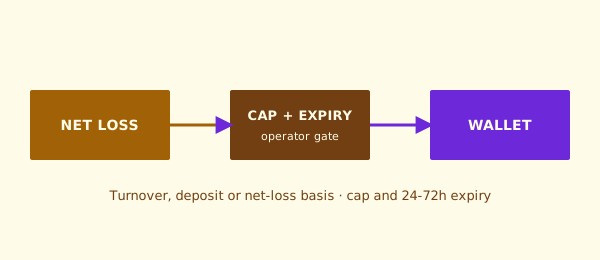
On the surface this looks pro-consumer. In practice it is the model most closely correlated with problem-gambling behaviour, because it rewards losing sessions rather than winning ones. A player who is on a losing streak sees the cashback as partial compensation, which reduces the perceived cost of the next deposit. That effect is documented in the academic literature on gambling reward-timing.
- Net-loss cashback rewards the specific behaviour operators most want to sustain.
- It creates a false floor under the perceived cost of losses.
- Its headline percentage looks larger than turnover cashback but only pays when the account is losing.
- Most net-loss programmes credit to bonus balance rather than cash, which means a wagering multiplier applies before the rebate can be withdrawn.
The consumer takeaway is that a large net-loss cashback percentage is not a signal that the operator is generous. It is a signal that the operator has priced the specific behaviour it wants to encourage.
Turnover cashback and its steady drag
Turnover cashback pays a fraction of a percent of total amount wagered, regardless of session outcome. It is the model most familiar to anyone who has held a comp-earning credit card: every unit of activity generates a proportional rebate.
Turnover cashback percentages are much smaller than net-loss cashback percentages — commonly between 0.1% and 0.7% — but they apply to a much larger base. A player wagering twenty thousand pounds of slot volume in a month at 0.5% turnover cashback receives a hundred pounds. That flat rate is more predictable than a net-loss rebate and, from a consumer perspective, more honest.
The commercial logic is straightforward. Turnover cashback prices retention against a stable metric — total wagered — and does not create the perverse incentive of net-loss cashback. Operators use it primarily at higher VIP tiers, where the retention team wants to reward the largest players without accidentally increasing risk for players on losing streaks.
Deposit-based cashback and hidden wagering
Deposit-based cashback pays a small percentage of each deposit — commonly two to five percent — often capped at a low three-figure amount per week or month. It is the least transparent of the three models, because the headline number sits alongside a wagering multiplier that neutralises most of the rebate.
A five-percent deposit cashback on a hundred-pound deposit generates a five-pound cashback credit. If that credit is issued with a three-times wagering multiplier, the player must wager fifteen pounds through eligible games before the five pounds can be withdrawn. In slot terms, that is roughly a fifteen-pound test of variance against a five-pound reward — a proposition that mostly benefits the operator.
Deposit-based cashback often carries maximum-bet clauses inside the wagering window. A five-pound cap on active bets while cashback is being wagered is common. Breach the cap and the operator voids the cashback and any winnings derived from it. That clause is usually visible only in the specific promotion's terms.
Caps and ceilings that neutralise the headline rate
Every cashback offer worth reading has a cap. The cap is where the headline percentage collapses into a fixed maximum, and understanding it is the single most useful thing a consumer can do when comparing programmes across the offshore market.
| Programme model | Headline rate | Typical weekly cap | Effective rate at heavy play |
|---|---|---|---|
| Net-loss (silver) | 5% | £250 | ≤ 2% |
| Net-loss (platinum) | 10-12% | £1,000 | ≤ 5% |
| Turnover (gold) | 0.5% | £500 | ~ 0.5% |
| Turnover (diamond) | 0.8% | £2,500 | ~ 0.8% |
| Deposit-based | 3-5% | £150 | ≤ 1% after wagering |
The pattern is consistent. Turnover cashback maintains its headline rate at any activity level, because the rate scales with wagering. Net-loss cashback collapses well below its headline rate for heavy players, because the cap intercepts. Deposit-based cashback rarely reaches half of its headline rate once wagering is applied.
A useful consumer discipline is to convert every headline cashback offer into its worst-case effective rate before opting in. If the effective rate does not justify the additional turnover it will invite, the offer is not net-positive for the consumer.
Expiry windows and the frequency lever
Cashback expiry is where the operator sets the session frequency lever. A cashback credited with a 24-hour expiry is not a rebate; it is a scheduling tool. The credit exists to bring the player back into a session inside a specific window.
- Same-day expiry (rare, high-value): forces immediate re-entry.
- 24-hour expiry: forces re-entry within the next daily cycle.
- 48- to 72-hour expiry: covers the standard weekly retention pattern.
- Seven-day expiry: the norm at reputable non-UKGC operators.
- Thirty-day expiry: rare, and usually only on real-wallet turnover cashback at the top VIP tiers.
A cashback with a short expiry window forfeits a large share of its value. Any credit not wagered within the window is deducted, and the operator retains the funds. For a consumer thinking about the cost of the offer honestly, the expiry rate is functionally a discount to the headline percentage.
Game weighting and category exclusions
Cashback rarely applies uniformly across the game library. Slots typically count at full weight. Live-dealer games often count at zero or at a small fraction. Table games count somewhere between. Progressive jackpots are usually excluded entirely.
This weighting is meaningful in two directions. Firstly, it means a player who prefers table games or live dealer sees a substantially lower effective cashback rate than the marketing implies. Secondly, it steers new cashback participants toward slots — the game category with the highest gross gaming revenue for the operator — which is the direction the operator's retention team wants steered.
Category exclusions are also common. New releases from a specific studio may be excluded for the first ninety days after launch. Certain jackpot titles may be permanently excluded. Some operators exclude specific bonus buy features. Read the exclusion list before assuming a favourite game qualifies.
Effective rate — worked examples
Two worked examples clarify the arithmetic. First example: a silver-tier player deposits two thousand pounds in a week, wagers ten thousand through slots at full cashback weight, and finishes the week with a net loss of eight hundred pounds. The programme is a 5% net-loss cashback capped at two hundred pounds per week with a two-times wagering multiplier and a 72-hour expiry.
- Raw cashback: 5% of 800 = £40, well under the cap.
- Credited to bonus balance with 2x wagering; player must wager 80 through eligible games.
- Expected loss on that 80 at slot RTP of ~96%: approximately £3.20.
- Net expected value of the cashback: £40 − £3.20 ≈ £36.80.
- Effective rate against the losing 800: about 4.6%, before considering the marginal risk of the wagering session extending beyond 80.
Second example: a platinum player wagers thirty thousand pounds in a week and finishes exactly flat. The programme is a 0.6% turnover cashback capped at three hundred pounds per week, paid to real balance with no wagering multiplier.
- Raw cashback: 0.6% of 30,000 = £180, under the cap.
- Paid directly to real balance.
- Effective rate: 0.6% of turnover, exactly as advertised.
The difference between the two is instructive. The larger headline (5%) delivers substantially less absolute value than the smaller headline (0.6%) at heavy turnover, because turnover cashback scales with volume while net-loss cashback is bounded by losses and by cap.
A third example is worth walking through briefly. Consider a deposit-based five-percent cashback with a fifty-pound cap per deposit and a three-times wagering multiplier. A player depositing five hundred pounds receives a raw cashback of twenty-five pounds, credited to bonus balance. To clear the wagering the player has to wager seventy-five pounds through slots at full weight; at a 96% slot RTP the expected loss on that wagering is around three pounds. The net expected value of the cashback is therefore about twenty-two pounds — well below the five-percent headline. That gap is where the marketing works and where the consumer decision has to be honest.
Operator disclosure comparison
Not all offshore operators disclose their cashback terms to the same standard. Some publish full cap and expiry structures in the promotions page. Others require a login before the cap becomes visible. A small number reserve cap disclosure to the account manager, which is a genuine consumer red flag.
| Disclosure standard | What is public | Consumer takeaway |
|---|---|---|
| Full | Rate, cap, expiry, wagering, weighting | Comparable across operators |
| Partial | Rate and cap only | Effective rate unknown until first credit |
| Manager-only | Nothing public | Terms are discretionary; treat with caution |
Reputable non-UKGC operators tend to publish full disclosure. The presence of full disclosure is one of the few reliable indicators of an operator willing to be held to consumer standards. Its absence is a signal that the retention team retains too much discretion for the terms to be reliably compared.
One further disclosure detail worth checking is whether the cashback percentage applies before or after any bonus-funded wagering. Some operators exclude wagering funded from a prior bonus balance from the cashback calculation entirely, which can strip a meaningful share of the effective rebate from a player who has been chaining reload offers. Others include all wagering regardless of funding source. The difference is not usually stated on the promotions page and often only becomes visible in the specific terms document that governs the cashback offer.
Independent affiliate comparison pages sometimes surface these differences, but the incentives inside the affiliate market are aligned with the operators' marketing goals rather than with honest consumer disclosure. Read affiliate rankings against the operator's own terms document, and where the two disagree the terms document is the load-bearing artefact.
Frequently Asked Questions
Is cashback taxable in the UK?
No. Gambling winnings and rebates received by individuals in the UK are not subject to UK income tax, and that treatment applies regardless of operator jurisdiction. Cashback received from an offshore operator is treated identically to cashback from a UKGC-licensed brand for personal-tax purposes.
Why is my cashback smaller than the headline percentage?
Because caps, game weighting, expiry windows and wagering multipliers all apply after the headline rate is calculated. The gap between marketing and effective rate is where operator margin sits.
How often is cashback paid?
Most programmes credit weekly. Some pay daily on smaller caps, some monthly at higher tiers, and some on a rolling review that never quite lands on a fixed schedule. The crediting cycle is the primary driver of session frequency.
Does cashback stack with reload bonuses?
Occasionally, but exclusion clauses are common. Any assumption of stacking should be verified in the specific reload promotion's terms before opting in.
Is net-loss cashback always better than turnover cashback?
No. Net-loss cashback correlates with losing sessions, which is the opposite of a safe reward pattern. Turnover cashback is usually a smaller headline but is less behaviour-distorting and pays regardless of session outcome.
Can cashback be withdrawn immediately?
Rarely. Most cashback is credited as bonus balance with a one- or three-times wagering multiplier before it becomes withdrawable, and cashback credited to real balance is generally reserved for the top VIP tiers.
Responsible Gambling
Cashback is often framed as a safety net. It is not. A cashback rebate returns a small fraction of losses, credited against terms the operator sets, in a form that requires further wagering to become withdrawable. The overwhelming direction of travel inside a cashback session is toward more play, not less.
GamStop is the UK's national self-exclusion register. It works, and it is free. Anyone who has previously registered and is now considering a cashback offer at an offshore operator is looking at a specific attempt by the retention model to reactivate the exact pattern the register was designed to interrupt.
Free confidential support is available. GamCare operates a 24-hour helpline on 0808 8020 133. Gordon Moody provides residential treatment for severe cases. The NHS National Gambling Clinic offers specialist care through referral. BeGambleAware maintains independent information services. GAM-Anon supports family members. These are text-only references; contact them directly rather than through any operator link.
Background material is publicly available at the Gambling Act 2005 on legislation.gov.uk, at the general gov.uk portal, and internationally via the OECD. Encyclopedic context on the primary UK statute is available at Wikipedia.

Amelia examines VIP, loyalty and cashback programmes across offshore operators, mapping the fine-print behind headline rates and what triggers VIP-tier reviews.